Sunday, 10 March 2024

Indian Poetics & Aesthetics (ThAct)

 Greetings!! Everyone This blog is a part of thinking activity on Indian Poetics; given by Dr. Dilip Barad sir. 


Indian poetics stands as one of the earliest forms of literary criticism, tracing back to ancient times. Throughout India's scholarly history, numerous attempts have been made to define literary theories meticulously. Interestingly, each theory seems to hold its own validity, presenting a challenge in singling out a definitive one. Yet, amidst this diversity, certain key characteristics emerge, distinguishing and granting prominence to each theory within the realm of literary discourse.

A fundamental notion within Indian literary discourse revolves around the tripartite nature of imagery: dreams, the realm of memory, and imagination. Dreams and memories are immutable, beyond alteration or interruption. However, it is the realm of imagination that emerges as the pivotal force, offering a canvas for literary creation. This imaginative faculty serves as the cornerstone for the genesis of literary art, wielding the power to transcend boundaries and manifest intricate narratives.

Delving into Indian literary criticism necessitates an appreciation for the intrinsic connection between literature and self-reflection. Literature becomes a mirror through which we endeavor to envision ourselves, a profound exploration of the human experience. Within the framework of Indian Aesthetics, diverse schools of thought endeavor to elucidate various facets of poetics, each contributing to the rich tapestry of literary discourse.

> There are six schools of Indian poetics,...

1. Rasa theory by Bharata
   { For more information about Rasa                        theory CLICK HERE }
2. Dhvani theory by Anandvardhan
3. Vakrokti theory by Kuntaka
4. Alamkara by Bhamaha
5. Riti by Vaman
6.Auchitya by Kshemendra


1. Dhvani Theory by Anand-vardhan:-

Dhvani theory is a fundamental concept in Indian poetics, particularly in the Sanskrit tradition, which elucidates the multilayered significance and aesthetic experience of poetry. Dhvani, literally meaning "suggestion" or "resonance," goes beyond the literal meaning of words to convey deeper emotions, sentiments, and aesthetic experiences to the reader or listener.

The significance of Dhvani theory lies in its ability to elevate poetry from mere linguistic expression to a profound aesthetic experience. It acknowledges that the beauty and power of poetry lie not only in its surface meaning (vachya artha) but also in its suggestive or evocative meaning (dhvani). This theory recognizes the subjective response of the reader or listener, emphasizing the role of suggestion and resonance in evoking emotions, creating imagery, and conveying the poet's intended message.

Anand-Vardhan was the originator critic of Dhvani theory and he wrote a book on Dhvani named "Dhvanyalok".

Simply we can say that "Dhvani" means with help of this theory one can complete a word or produce sound and make a whole word. One example of Dhvani theory,

                            "તમારી લાલ પેન્સીલ મને આપો."


> According to Dhvani theory; given example we can interpret like this,


  1. 1. Emphasis on "Your":-


  2. "Your pencil, red pencil, give, and give it to me" could imply that the speaker is addressing someone about their pencil, which happens to be red, and they're requesting it be given to them.


  3. 2. Emphasis on "pencil":-


  4. "Your pencil, red pencil, give, and give it to me" might suggest that there are multiple items being mentioned, such as two pencils, one of which is red. The speaker then requests that one of the pencils be given to them.


  5. 3. Emphasis on "red":-


  6. "Your pencil, red pencil, give, and give it to me" could indicate that there are multiple pencils, but one is specifically red. The speaker might be expressing a preference for the red pencil and requesting it be given to them.


  7. 4. Emphasis on "give":-


  8. "Your pencil, red pencil, give, and give it to me" could imply a sense of urgency or insistence on the action of giving. The speaker may be emphasizing the act of giving the pencil to them.


  9. 5. Emphasis on "it":-


  10. "Your pencil, red pencil, give, and give it to me" could suggest that there is something specific about the pencil being referred to, perhaps its color or its condition. The speaker is requesting that particular pencil be given to them.


  11. 6. Emphasis on "me":-


  12. "Your pencil, red pencil, give, and give it to me" might imply that the speaker is emphasizing who the pencil should be given to, asserting that it should be given to them specifically.


"Acharya Mammata devides Dhavni in three parts."

शक्तिःकावितवबीजरूपे संस्कारविशेसप्राप्ते याम्विना काव्य न प्रसरित।


In Raghuvansh Kalidas compared Shabda and Artha to Lord Shiva-Parvti.


वागर्थाविव सम्पृक्तौ वागर्थप्रतिपत्तये ।

जगतः पितरौ वन्दे पार्वतीपरमेश्वरौ ॥


> Three types of Dhvani:-


1. अभिधा (Abhidha) >> It refers to direct or literal meaning. It is the straightforward interpretation of words or expressions without any implied or suggested meaning.


2. लक्षणा (Lakshana) >> Lakshana refers to suggested or implied meaning. It involves understanding the intended meaning beyond the literal interpretation of words or expressions. It includes figures of speech, metaphors, similes, etc.


3. व्यंजना (Vyanjana) >>  Vyanjana refers to the suggested meaning that arises from the implication or suggestion within the context. It involves understanding the subtle nuances or connotations of words or expressions beyond their literal meaning.


2. Vakrokti Theory by Kuntaka:-

शब्‍दार्थौ सहितौ वक्र कवि व्‍यापारशालिनि।

बन्धे व्‍यवस्थितौ काव्‍यं तद्विदाह्लादकारिणी।।


In his work "Vakrokti-jivitam," Kuntaka highlighted the significance of transcendent expressions. Vakrokti, which embodies a poetic finesse, entails statements that diverge significantly from ordinary speech, known as Loka-varta. This concept is intricately linked with the aesthetics theory, emphasizing the artistry and uniqueness of poetic utterances.

> Example:-

"જેવા નાહ્યા પછીના નખ કૂણાં, સખી મારા સાજન એવા સલુણાં"


> Vakrokti can be divided in six categories:-

1.વર્ણવિન્યાસ- the phonetic level:-

Repetation of varna and music in it.

नव कंज लोचन कंज मुखकर कंज पद कन्जारुणम ।


2. પદપૂર્વાર્ધ- the lexical level:-

હરિવર મુજને હરિ ગયો મેં તો કઈ હેત કીધું નોતું 

3. પદપરાર્ધ- the grammatical level:-

The whole sentence is depended on first letter.

4. વાક્યવક્રતા- the sentential level:-

An enchanting description of an object.  

"To be or not to be, that is the question."
"સંપ ત્યાં જંપ"

5. પ્રકરણ- the contextual level:- 

Taking a part of any literary art or legend and enlargement of it by poet’s own interpretation.

Antony's speech in Julier Caesar and Viti Abhignan in Abhignan Shakuntalam are examples of it. If we remove this then whole work would be meaningless. 

6. પ્રબંધ- the compositional level :-

One linear meaning of a whole text or any literary art. 
1. રામાયણ- સદબુદ્ધિ અને લોકકલ્યાણ 
2.મહાભારત- દુઃખ સનાતન સત્ય 
3.હિતોપદેશ અને પંચતંત્ર ની વાર્તા


3. Alankara by Bhamaha:-


Bhamaha thinks that there can be no alamkara without vakrokti since this is the factor that differentiates between the language of poetry and the language of ordinary life. Poetical language aims at being striking and arresting. It is Vakrokti that provides poetry with the strikingness of both language and thought. According to Bhamaha strikingness of meaning is at the root of all poetic figures. Although some scholars before Bhamaha considered Varta and Swabhabokti as alamkara but Bhamaha thinks that such matter of fact statements comprise of words that are only news and as such cannot be called Kavya.

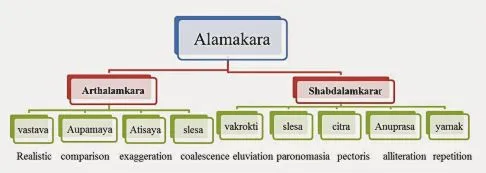
Almkara, which translates to "ornaments," serves as a literary embellishment. Figures of speech or metaphors are employed in literature to enhance language's allure. According to Bhamaha, if Almkara is glaringly obvious in a poem, the poet has faltered. The art lies in subtly weaving Almkara into the text, ensuring its presence is not overt yet adds pleasure to the reading experience. Vishvnath, in Sahityadarpna, delineates 96 such Almkaras.

1. Upama or Simile
2. Rupaka or Metaphor 
3. Atishayokti or Epithet 
4. Anuprasa or Alliteration
5. Vakrokti or Irony
6. Dhwani or Suggestion


4. Riti by Vamana :-

The concept of Riti was highlighted by Dandin and Vamana. Theory of Riti relates to the particular arrangement of sounds combined with poetic excellence. Riti is the going or the flowing together of the elements of a poem. The language and its structural form lead us to the inner core of poetry.

'रीतिरात्मा काव्यस्य; विशिष्टापदरचना रीति: |'

Riti, in essence, embodies style. Acharya Vamana's poetic masterpiece, Kavyalankasutra, delves into the concept of riti. According to Vamana, riti represents the formless, indeterminate essence of poetry. He asserts that, akin to the soul within every body, every piece of poetry possesses its own distinct riti. Vamana succinctly declares that riti is the very soul of poetry (रीतिरात्मा काव्यस्य), encapsulating the profound connection between form and substance in literary expression.

Different patterns or styles often dictate the writing style, influencing the form in which a piece is crafted. For instance, a sonnet typically adheres to the structure of 14 lines, while a drama is usually presented in dialogue form. Kalidasa is renowned for his mastery of the 'Vaidarbhi Shaili,' a particular style of writing. Other notable styles include Panchali, Gaudi, Lati, and Vaidarbhi, each contributing unique characteristics to literary compositions.


5. Auchitya by Kshemendra


उचितं प्राहुराचार्याः सदृशं किल यस्य यत्।
उचितस्य च यो भावस्तदौचित्यं प्रचक्षते॥


He remarked that Auchitya breathes life into poetry (Kavyasya jivitam), which is adorned with Rasa. Auchitya, he emphasized, stands as the cornerstone of Rasa. It is demonstrated by the seamless alignment between the conveyed sounds and the evoked Rasa. Furthermore, he defined Auchitya as the commendable quality that enriches poetry with joy. Kshemendra posited, "Auchitya is when one element aptly fits or harmonizes with another; it's what defines appropriateness."


Thank you for reading...
Happy learning...Exploring...


Saturday, 9 March 2024

Indian Poetics and Aesthetics - RASA Theory (TheAct)


Greetings!! Everyone This blog is a part of thinking activity on Indian Poetics; given by Dr. Dilip Barad sir. 


# Introduction:-


Indian poetics, a realm as expansive as it is diverse, encapsulates the rich tapestry of traditional poetry and literary critique within Indian literature. These frameworks, referred to as Alankaras, are found upon the tenets of rhetoric and aesthetics, forming the cornerstone of the exploration and admiration of Indian verse and prose.

Among the earliest and most impactful treatises on Indian poetics stands the Natyashastra, authored by the venerable Indian sage Bharata Muni. Originating around the 2nd century BCE, this seminal work elucidates fundamental principles of Indian poetics, prominently featuring the concept of rasa, wherein art strives to evoke specific emotional resonances within its audience.

Integral to Indian poetics is the notion of Dhvani, denoting "suggestion" or "implication," emphasizing the strategic deployment of literary devices to evoke distinct emotional and aesthetic responses. This encompasses metaphors, similes, and other rhetorical devices.

Furthermore, Indian poetics embraces Alankara, signifying "ornamentation" or "embellishment," which encompasses the utilization of literary adornments such as alliteration, rhyme, and meter to enrich and intensify the allure of literary works.

Beyond these core concepts lie a myriad of additional literary devices and techniques woven into the fabric of Indian poetics. From evocative imagery to symbolic motifs and intricate narrative structures, these elements collectively contribute to the multifaceted landscape of Indian literature.

In essence, Indian poetics emerges as a nuanced and multifaceted discipline that has exerted a profound influence on the development of Indian literary traditions and cultural ethos throughout the ages.

Within Indian poetics, we encounter six distinct schools of theoretical thought, each offering unique perspectives and insights into the intricate artistry of Kavya, the poetry of India.


# Let's First discuss about the "RASA" theory in Indian Poetics:-


Rasa theory is a fundamental concept in Indian poetics, particularly in the realm of classical Sanskrit literature. It's an intricate framework used to analyze and understand the emotional impact of artistic expression, particularly in poetry, drama, and other performing arts.

At its core, rasa theory explores the idea that the purpose of art is to evoke emotions in the audience. The Sanskrit word "rasa" literally translates to "juice" or "essence," suggesting that the aim of artistic creation is to extract and communicate the essence of human emotions.

There are 9 different rasas in Indian Poetics which all are based on expressions,...

There is one Sanskrit verse by Abhinav Gupta for understand these 9 Rasa in easier way,...

शृंगार करुण वीर,

रौद्र हास्य भयानक।

बिभत्स्यद्रभुत शांतश्व,

नव नाट्य रसा: स्मृता।।

                    - अभिनव गुप्त 


RasaMeaningEmotion/ SentimentAssociated Elements
ShringaraLove/BeautyErotic, romanticCupid, flowers, music
HasyaLaughterComic, humorousWit, satire, jesters
KarunaCompassionPathetic, sympathySuffering, tears
RaudraFuryFurious, angryThunder, bold gestures
VeeraHeroicValorous, courageousBattle, bravery
BhayanakaFearFrightening, dreadfulDarkness, ominous sounds
BibhatsaDisgustRevolting, repulsiveUgliness, grotesque
AdbhutaWonderAmazement, marvelSupernatural, miracles
ShantaTranquilityPeaceful, calmSerenity, gentle sounds

# Let's Discuss the detail information about all 9 Rasas:-

The roots of Rasa theory in Indian poetics can be traced back to ancient Sanskrit texts, particularly Bharata Muni's "Natya Shastra." Bharata Muni is considered the founder of Rasa theory. "Natya Shastra" is one of the earliest and most comprehensive treatises on dramaturgy and performing arts in the world. In the "Natya Shastra," Bharata Muni discusses various aspects of theater, including the aesthetics of performance, emotions, gestures, music, and the psychology of the audience. Central to the theory is the concept of Rasa, which refers to the emotional essence or flavor evoked in the audience by a work of art, particularly in drama. According to Rasa theory, there are nine primary emotions or Rasas: Shringara (erotic), Hasya (comic), Karuna (pathetic), Raudra (furious), Veera (heroic), Bhayanaka (terrifying), Bibhatsa (odious), Adbhuta (marvelous), and Shanta (peaceful). Each Rasa is associated with a particular sentiment, and the successful portrayal of these emotions in a performance is believed to evoke a corresponding emotional response in the audience. Bharata Muni's "Natya Shastra" laid the foundation for the development of Indian aesthetics and continues to be a significant influence on classical Indian art forms, including dance, music, and theater. His insights into human emotions and the art of evoking them have had a profound impact not only on Indian culture but also on the broader understanding of aesthetics and performance worldwide.

Moreover we can also say that Bharat Muni explained the Rasa theory in Natya Shastra, an old Sanskrit book about the arts from over a thousand years ago. This theory mainly focuses on drama. Although the idea started with Bharat Muni, the Kashmiri philosopher Abhinavgupta provided a more detailed explanation in his works, showing that the artistic tradition in ancient India has been around for a long time.

> Rasa and Bhava both are inter linked Rasas comes from Bhavas and According to Bharat, understanding Indian literary criticism means seeing how feelings ("Bhava") and language are linked. "Bhava" is our natural connection to emotions from birth, even animals have it. But language is something we learn, not natural. Language helps express emotions, making it part of literature. Literature can't exist without language. But "Bhava" is crucial for literature too. In literature, we see ourselves, so it reflects who we are.

We can also find the theory of Rasa in chapter 6 of Natyashastra in which Bharat Muni talked about Shad Rasa (6 Rasa).
* ભાવનું ઉર્ધ્વીકરણ એટલે રસની પ્રાપ્તિ. *


There is one verse for Bhava,

विभावानुभावव्यभिचारिसंयोगाद्ररस निष्पत्ति:।

Rasa is produced from a combination of Vibhava, Anubhava and Vyabhicharibhava.

The main feelings mix with other emotions to create a mood, according to a book called साहित्य दर्पण (Sahitya Darpan). These main feelings guide us to temporary emotions. There are 33 types of these temporary emotions. They're like quick changes, similar to waves in the ocean. Also, they show up on our faces as expressions.

Another aspect to consider is the subtle Satvik Bhavas, often imperceptible to the naked eye. In the narrative of Kumarsambhav, when Narad presented the proposition regarding Shiva to Parvati, her lowered eyelids exemplified the essence of Satvik Bhavas.

Another example of Satwik Bhava was given by Manoj Khanderiya,..

બીજ માંથી પૂનમ દઈ દે સહેજ પાપં નમેલી ખોલી નાખ. 


Moreover we can also say that Rasaparpti essentially intertwines with the Western concept of "Art for Art's sake," linking the creator (Kalakar) with the audience's emotional experience (Bhavak).


# Basic Information about,...

1. Vibhav:-

Rasa emerges in conjunction with characters like Dushyant and Shakuntala in Abhijnanan Shankuntalam. In this narrative, they exemplify Almbanvibhav or Uddipan vibahav. Similarly, in the case of Romeo and Juliet, they represent vibhav-excitant.

2. Anubhav:-

Locations such as the tamala grove where Dushyant and Shakuntala encountered each other, the oak tree in Romeo and Juliet's tale, and the garden serve as prime instances of 'anubhav' or experiential settings. However, Ra. Vi. Pathak's "Khemi" stands out as an exception in the realm of 'anubhav'. 

3. Vyabhicharibhav:-

It resembles the Sanchari Bhavas, representing fleeting emotions, originating directly from emotional states. An instance of this is experiencing depression due to profound sorrow. At times, these sentiments interlink with multiple emotions in from a sense of sorrow.

4. Sainyog(Samyog):-

સમ + યોગ in this we can analyze that mixture and samyog interlink with each other and which helps to produce the Rasa.

There were some critics in Bharata's definition of Rasa; to whom Bharata was fail to answered their arguments,..

1. Bhatt Lollat
2. Shri Shankuk
3. Bhatt Nayak
4. Abhinavgupta

> According to Bhatt Lollat there is no Rasa ; One has to produce Rasa when a play is played at that time actors have to performed as like with all the expressions which includes all the particular Rasas. Ex. Metamorphosis; Mina Kumari

> According to Shri Shankuk there is no Rasa or Rasa can not produce by anyone just one can guess the Rasa. It also known as "Anumitivaad".

> According to Bhatt Nayak Rasa can be produce in simple way by one who is performing any kind of art.

> According to Abhinav Gupta many times audience can not be get over from sthayi bhava at that time comic element produce the Rasabhas, Purvabhas or Rasavighna.

In concluding part according to my understanding During the final dialogue, all the spiritual leaders delved into the topic of poetic delight. They emphasized that we can truly savor the beauty of poetry when a specific occurrence is elevated to a universal experience.


Thank You For reading...
Happy Learning...Exploring...


Paper:209 Academic Integrity in Research Methodology: The Role of Anti-Plagiarism Ethics in Fostering Originality and Trust in Scholarship

  Greetings!! Everyone this blog is based on an assignment of 'Research Methodology.' ASSIGNMENT: 209 Academic Integrity in Research...